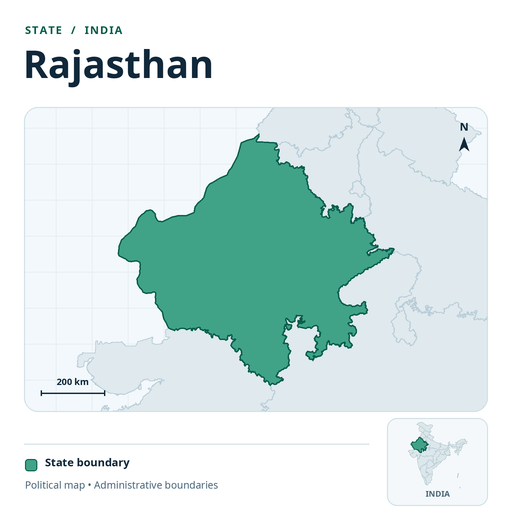
Planning hydroponic farm construction in Pilani? Pilani is a small town in Jhunjhunu district, Rajasthan, home to about 30,000 people (GeoNames)[1][2], about 160 km from Delhi. Below we use the town's monthly temperatures, humidity and rainfall to work out which structure fits, which crops to grow and in which months, before you spend on construction.
Climate for hydroponic farm construction in Pilani
May is the hottest month in Pilani, with average daily highs of about 42°C. January has the coolest nights, averaging 7°C.[3] Rain is scarce: about 471 mm a year. Water for the farm will come from a borewell, well, tanker or municipal supply, so test its salts (EC) and hardness before choosing the system. Pilani sits about 279 m above sea level.[2] On the Köppen–Geiger climate map, Pilani falls in the hot semi-arid zone (BSh).[4]
Pilani climate by month
Month
Avg high (°C)
Avg low (°C)
Humidity (%)
Rain (mm)
Jan
21.2
6.8
38
8
Feb
25.4
9.7
35
14
Mar
31.9
15.6
30
16
Apr
38.2
22.0
24
16
May
42.0
27.3
23
31
Jun
41.7
30.0
35
65
Jul
38.2
28.8
53
124
Aug
36.2
26.9
61
114
Sep
36.0
24.3
54
68
Oct
34.2
19.8
36
7
Nov
28.4
14.0
33
4
Dec
23.0
8.8
35
4
Area averages (a grid cell of about 50 km) for 2001–2025, from NASA POWER, centred on Pilani. Rainfall and night temperatures at your plot can differ, especially near hills and the coast.[3]
Which greenhouse suits Pilani?
For hydroponic farm construction in Pilani, the structure decides which months you can crop and what it costs to run. The heat in Pilani comes with dry air. In April to July, average highs reach 42°C while average humidity is only about 34%. In that dry air, wet pads can bring a 42°C May afternoon down to roughly 30°C inside a Fan & Pad polyhouse, which keeps herbs and vine crops going; lettuce will still struggle in the hottest weeks. For vine crops such as capsicum and cucumber, a naturally ventilated polyhouse with a shade screen works from November and costs less to run.
Sunlight peaks in May at about 7.0 kWh per m² a day, so add a shade screen for leafy greens in the brightest months.
Hydroponic crops for Pilani
Based on Pilani's climate, the crops with the longest growing windows are mint (9 months), coriander (8 months) and basil (8 months). Mint fits February to May and August to December with Fan & Pad cooling. These are the crops we would plan first for hydroponic farm construction in Pilani.
Months each crop suits in Pilani
Crop
Naturally ventilated polyhouse
With Fan & Pad cooling
Lettuce
Dec–Feb
Oct–Apr
Spinach
Dec–Feb
Oct–Apr
Coriander
Nov–Feb
Sep–Apr
Parsley
Dec–Feb
Oct–Apr
Basil
Mar and Nov
Mar–May and Jul–Nov
Mint
Feb–Mar and Nov–Dec
Feb–May and Aug–Dec
Cucumber
Mar and Nov
Mar–May and Jul–Nov
Tomato
Feb and Nov
Feb–Apr and Sep–Nov
Capsicum
Nov
Mar–Apr and Sep–Nov
Strawberry
Dec–Jan
Nov–Feb
Kryzen planning estimate from the monthly averages above and each crop's usual day and night temperature range. Variety, nutrient temperature and shading change the result, so confirm with a trial.
₹6,640Spending per person per month, urban Rajasthan, 2023–24[5]
160 kmto Delhi, the nearest metro (straight line)
Urban households in Rajasthan spent an average of ₹6,640 per person per month in 2023–24, below the all-India urban average of ₹7,078.[5] Local demand in Pilani may be small for exotic greens, so plan where the rest of the harvest goes. For premium salad and herb buyers, Delhi is within a day's delivery, about 160 km away.
Hydroponic farm construction in Pilani with Kryzen
We have built 6 projects in Rajasthan so far (see our project map (opens in a new tab)). Pilani is about 940 km in a straight line from our Chhatrapati Sambhajinagar warehouse, our nearest site.
Towns near Pilani
We also plan and build farms in these towns near Pilani:
Map: LGD 2024 boundaries via bharatlas, CC BY 4.0. For illustration only.
Hydroponic farm construction in Pilani: FAQs
Can a hydroponic farm run all year in Pilani?
Yes, with the right structure. For Pilani we would plan a Fan & Pad polyhouse for leafy greens. Even then, lettuce is hard to grow in May to September, so plan another crop for those months.
Which polyhouse is best for Pilani?
With May highs of about 42°C and 23% average humidity in that month, we would start with a Fan & Pad polyhouse for leafy greens.
Which hydroponic crops should I start with in Pilani?
Going by the monthly climate, mint, coriander and basil have the longest growing windows. Confirm prices and volumes with buyers before you plant.
Does Kryzen build hydroponic farms in Pilani?
Yes. Our nearest site is our Chhatrapati Sambhajinagar warehouse, about 940 km away, and we have built 6 projects in Rajasthan.
Is there a subsidy for polyhouse or hydroponic farms in Rajasthan?
Yes. Protected cultivation projects in Rajasthan can apply for Mission for Integrated Development of Horticulture (MIDH) assistance through the state horticulture department. Check the current rate and area limit when you apply.
Discuss your Pilani farm project
Share your plot location, water test and crop targets. We will suggest the right structure and growing system, and send an itemised quotation.
A computer engineer turned hydroponic farmer from a multigenerational farming family in Satara. Sudhir founded Kryzen in 2019, and the team has since built 350+ protected and hydroponic farms across India.